
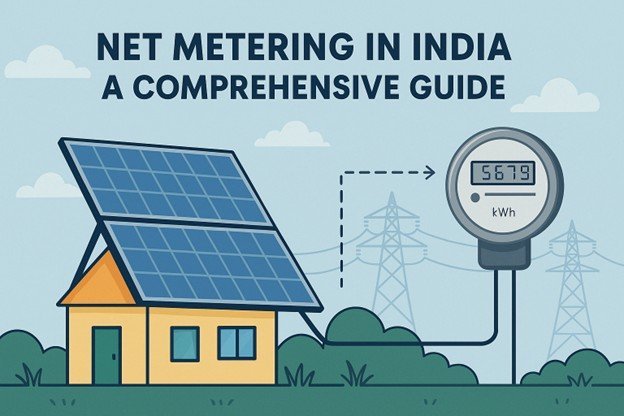
Net metering has become one of the most important parts of rooftop solar adoption in India.
It directly affects how much money you save from your solar power system.
In 2025 net metering rules continue to evolve as more households, apartments and businesses shift to solar energy.
Indian homeowners want clear and simple information.
This guide explains net metering policies in India for 2025 in a clean, readable and complete way with small sentences, simple vocabulary and full paragraphs.
I also include updated facts from top sources and integrate more relevant keywords like rooftop solar system, net metering policy India 2025, solar power savings, bi directional meter, grid connected solar system and DISCOM regulations.
What Is Net Metering and Why It Matters for Your Solar System
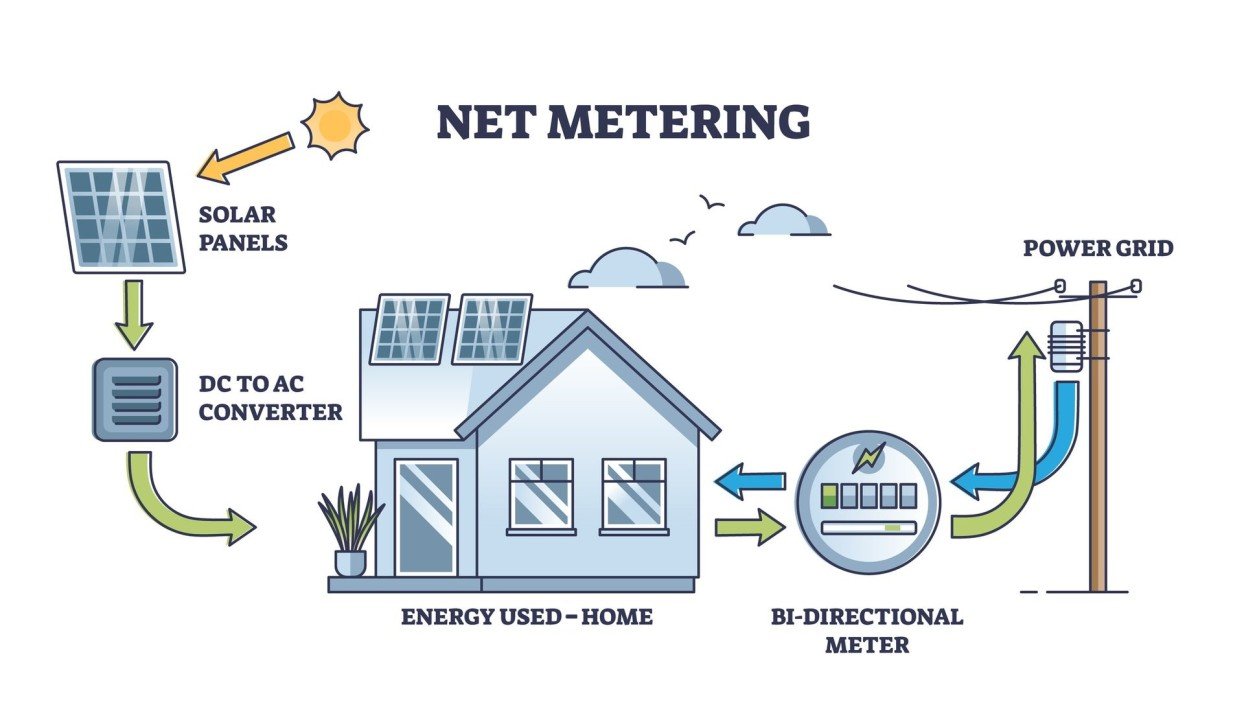
Net metering is a billing system for grid connected solar systems.
It allows your rooftop solar panels to send extra electricity back to the power grid.
Your meter then records both the electricity you import from the grid and the electricity you export to the grid.
At the end of the billing period the two are compared.
This is why it is called net metering.
Net metering matters because it increases the return on investment of your solar power plant.
It reduces your electricity bill.
If export credits are strong your payback period reduces.
This makes rooftop solar in India more affordable and practical for normal households.
Types of Net Metering Used in India in 2025
Different states and DISCOMs follow different net metering models.
These models affect how much benefit you receive.
Here are the common ones used in India in 2025.
Net Metering (Unit to Unit)
Imported units and exported units are compared.
Your final bill shows the difference.
This is the most homeowner friendly model because you use your extra solar units to offset your grid units.
Net Billing (Export Tariff Credit)
Your export is not offset in units.
Instead you get a fixed rupee amount for each exported unit.
This model gives lower savings than unit based net metering but is used in many states.
Gross Metering
All your solar power is exported to the grid at a feed in tariff.
You buy back your full consumption at the normal consumer tariff.
This is less common for residential users today.
Virtual Net Metering
Useful for apartments and group housing.
Solar panels are installed at one location.
Credits are shared among multiple consumers.
Group Net Metering
Several meters within one campus or society can share solar credits.
This model is used for residential colonies, institutions and commercial complexes.
These modern net metering models support India’s rooftop solar push and help more households take part even when rooftop space is limited.
Also Read How to Apply for MNRE Solar Subsidies in India in 2025: Complete Guide for Rooftop Solar Savings
Who Controls Net Metering Policies in India
Net metering rules are made at the state level.
State Electricity Regulatory Commissions issue regulations.
DISCOMs implement them.
MNRE provides national policies, guidelines and solar subsidy rules.
This mix means every state has slightly different limits, paperwork, timelines and credit rules.
Homeowners must always read the latest net metering policy published by their local DISCOM.
Common Capacity Limits in Net Metering for 2025
Most states fix rooftop solar capacity based on sanctioned load or a fixed maximum limit.
Typical patterns include:
- Residential solar system size allowed: from 1 kW to 10 kW or even 20 kW depending on state.
- Larger systems for commercial users: often 50 kW to 500 kW or more.
- Feeder or transformer level caps to avoid overloading.
- Some states allow up to 1 MW under net metering for large consumers.
These limits decide how big your rooftop solar installation can be.
Always check local rules before purchasing equipment.
How Net Metering Billing Works in Real Life
Every bi directional meter records two numbers:
- Import from the grid
- Export to the grid
The DISCOM then applies the billing method based on the state policy.
Monthly Settlement
Most states use monthly netting.
If you export more than you import a credit goes to the next month.
Annual Settlement
Some states allow annual settlement.
Excess credits build up for several months before the yearly settlement.
Export Tariff Credit
In net billing models each exported unit earns a fixed rupee value.
These rupees reduce the final bill.
Credit Expiry Rules
Some states allow unlimited credit carry forward.
Others expire credits annually.
Expired credits reduce the savings potential of your solar system.
Knowing these rules helps you size your system properly.
How Net Metering Supports Apartment Buildings and Housing Societies
Virtual net metering and group net metering models are becoming more common.
These models allow more families in apartments to enjoy solar energy.
Even if you do not have a private rooftop space your society can install a shared rooftop solar plant and distribute credits across all flats.
This promotes solar adoption in cities like Delhi, Mumbai, Chennai, Bengaluru and Pune where terrace space is limited.
Step-by-Step Process to Apply for Net Metering in India
(General Flow for Most States in 2025)
Application procedures vary slightly but this sequence is common in most states.
Step 1: Check Eligibility
You must be an existing electricity consumer.
Your rooftop must be shadow free.
Your system size must match your sanctioned load or state limits.
Step 2: Apply for Feasibility or No Objection Certificate
This is done through your DISCOM.
Your application includes connection details and proposed system capacity.
DISCOM checks transformer capacity and technical feasibility.
Step 3: Install Your Rooftop Solar System
Install only after receiving feasibility approval.
Use ALMM approved solar panels and certified inverters.
Maintain proper wiring and earthing.
Step 4: Submit Net Metering Application
Upload required documents such as invoices, panel and inverter datasheets, photographs, identity proof and the system’s single line diagram.
Step 5: Inspection by DISCOM
A DISCOM officer checks system safety, structure quality and equipment standards.
Step 6: Installation of the Bi Directional Net Meter
Your old meter is removed and a net meter is installed.
Now the system is officially connected to the grid.
Step 7: Start Generating and Monitor Your Bills
Your rooftop solar system starts exporting excess energy.
Your electricity bills show import, export and net settlement.
Required Documents for Net Metering Application
Homeowners usually need:
- Latest electricity bill
- Aadhaar or ID proof
- Roof ownership proof if required
- Solar panel invoice
- Inverter invoice
- Commissioning certificate
- Single line diagram
- Equipment datasheets
- Photographs of installation
- Vendor details and warranties
Keeping these ready avoids application delays.
Common Challenges in Net Metering and How to Avoid Them
Slow Processing by DISCOM
Follow up regularly.
Choose a vendor familiar with your local DISCOM.
Wrong Billing or Meter Reading
Check your bill every month.
Keep inverter generation logs.
Rejection Due to Transformer Overload
Apply early.
Choose a system size that matches technical limits.
Missing or Incorrect Documents
Submit complete paperwork.
Scan all files clearly.
Export Credit Confusion
Ask your DISCOM to confirm whether your state uses net metering or net billing.
Clarify carry forward rules.
Good preparation avoids many headaches.
How Net Metering Influences Solar System Size and Battery Decisions
If your state offers unit to unit net metering you can comfortably install a larger rooftop solar system.
If your state uses net billing with low export tariffs you may choose a smaller system to avoid exporting too much at low rates.
If your area has frequent power cuts you may add a solar battery system to shift daytime energy into night hours.
Understanding local net metering rules helps you design a smart rooftop solar setup.
Trends in Net Metering Policies in India 2025
Several new trends are visible in 2025:
- More states adopting virtual net metering for societies
- Increasing installation of bi directional smart meters
- Clearer online application systems
- Improved rooftop solar subsidy integration
- Rising demand for hybrid solar systems with battery backup
- Streamlining of transformer capacity rules to support higher rooftop penetration
Net metering regulations are moving toward transparency, digital applications and faster approvals.
How to Understand Your Net Meter Bill
A net meter bill shows:
- Imported energy
- Exported energy
- Net energy
- Adjusted credits
- Fixed charges
- Carry forward balance
Check every month if the export value is applied correctly.
Also check the meter reading number printed on the bill with your physical meter.
When Net Metering May Not Be the Best Option
Net metering gives high savings.
Still in some situations it may offer lower return:
- Your state offers low export tariff
- Credits expire yearly
- You consume very little electricity
- You have a battery based off grid system instead of a grid connected system
In such cases you must size your solar plant very carefully.
Quick Checklist Before Applying for Net Metering in 2025
- Check your DISCOM’s latest net metering regulation
- Confirm system size eligibility
- Use ALMM approved solar panels
- Choose BIS certified inverters
- Finalise a reliable solar installer
- Prepare all documents in advance
- Apply for feasibility before installation
- Keep a record of all submissions and approvals
This checklist helps you complete the process smoothly.
FAQs on Net Metering Policies in India 2025
1. Is net metering available for all residential users in India?
Most states allow net metering for residential rooftop solar systems.
However each state has its own rules, limits and procedures.
2. What is the benefit of net metering for a homeowner?
It reduces the electricity bill by offsetting imported and exported units.
This improves savings and reduces payback period.
3. Can apartments use net metering?
Yes. Virtual net metering and group net metering allow societies and apartment complexes to share solar credits.
4. Do net metering credits expire?
In some states credits carry forward for many months.
In others they expire annually.
Always check local rules.
5. Do I need a special meter for net metering?
Yes.
A bi directional net meter is required.
The DISCOM installs this meter during the inspection stage.